
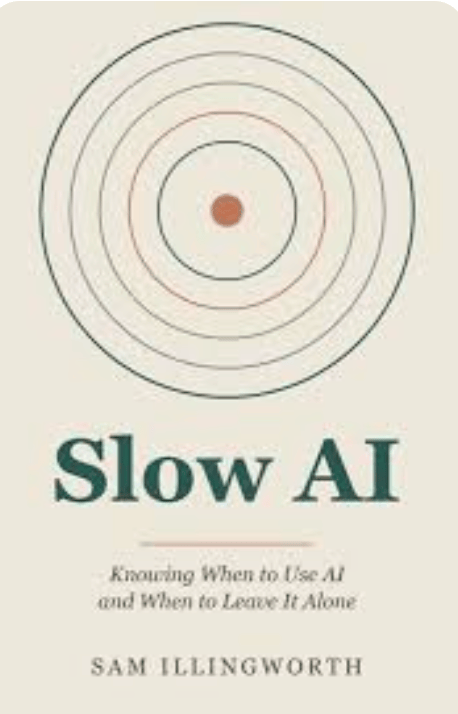
For the past few months, I’ve been searching for some guidance on AI use for you, my writing students.
Some of you are young just starting out on your careers, and some of you are veterans, recently retired perhaps, and keen to develop writing skills as a new challenge. So your familiarity and use of AI I assume will be most wide ranging. I wanted to find some insights and guidance which prioritize brain health above all else, and am thrilled to say I’ve found it.
Sam Ilingworth is Professor of Critical AI Literacy at Edinburgh Napier University, who works at the intersection of AI, education, and critical thinking. A former physicist and current poet, he’s also studied science and theatre for two years in Japan. As you’d expect from his professional title, Sam knows a great deal about AI, and is in constant communication with its various uses from his students. He’s also an exceptionally focussed and clear writer, in my view.
Here’s his sum up of a request to AI to act as critical poetry editor on one of his poems:
‘The machine supplied a sharp, outside eye, exactly as a good human editor does, and the poem is better for it. What it never touched is the first draft, because the first draft is where the thinking happens, ugly and tentative and full of wrong turns that lead somewhere. Artists have always borrowed editors, teachers, and sounding boards. The discipline that separates borrowing from surrender is knowing which part of the process is the work, and defending it’.
He describes four critical tests for AI use to direct its power towards a bounded task with human judgement, rather than an addiction machine with human in hock to it. The Amazon summary says: “It sits in the harder, more useful middle.” “This is exactly the book I didn’t know I needed.” “Very short but very much to the point.” There is no scaremongering, instead an exceptionally balanced and practically useful take.
The author has a popular substack, the Slow AI and for poetry lovers, a terrific online course, Science Communication and Poetry from Edinburgh Napier university.
Whether you’re a writer who takes a ‘hope it will all go away soon’ approach to AI, one who uses it prolifically and without qualm, or one who wonders ‘what is this doing to my brain?’ I bet that in this 101 pages, you’ll get your share of ‘aha!’ moments.

